

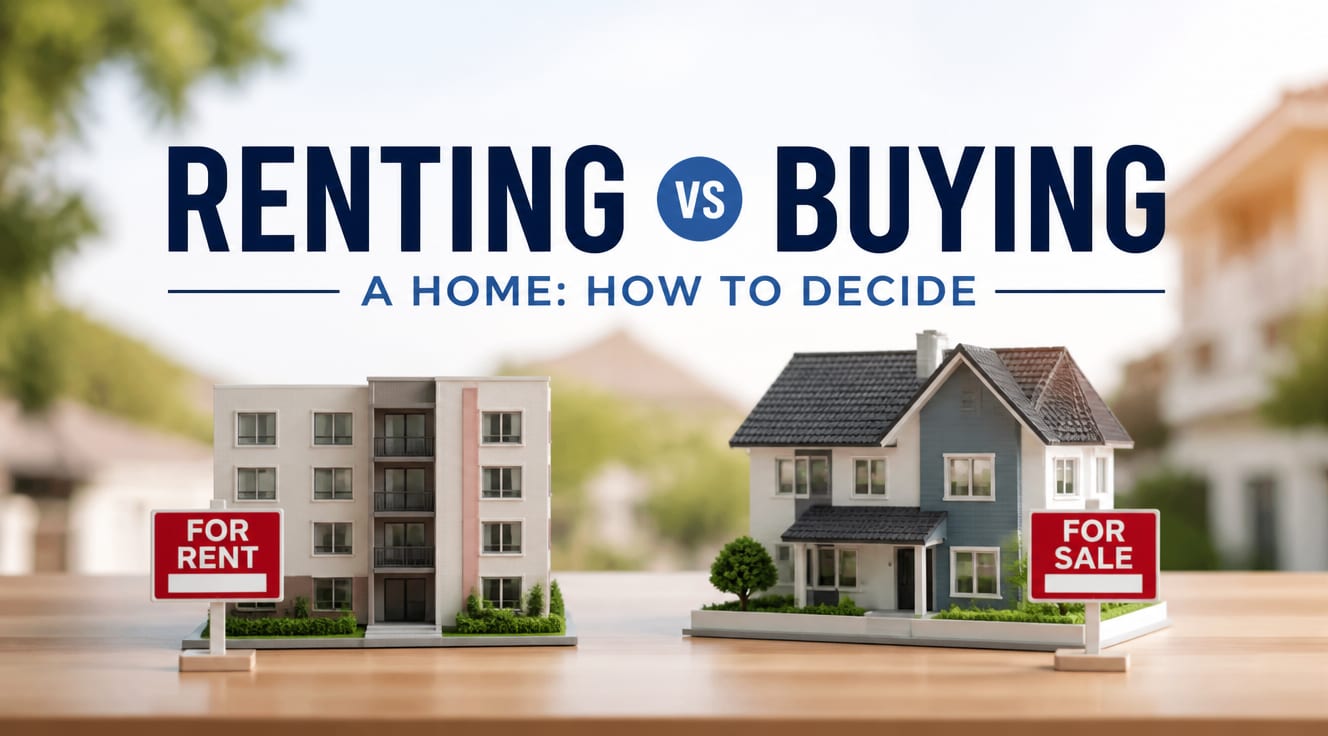
Deciding between renting vs buying a home comes down to three factors: your current finances, how long you plan to stay, and the local housing market. There is no universal winner, but a clear framework makes the right choice obvious for your situation.
This guide breaks down real costs, timing, and lifestyle factors so you can stop guessing and start deciding with confidence.
What does it actually cost to own versus rent in 2025?
Most people compare a rent check to a mortgage payment and call it a day. That comparison misses the full picture. Owning a home includes property taxes, insurance, maintenance, and opportunity cost on the down payment. Renting usually means predictable monthly costs and fewer surprise bills.
According to the U.S. Census Bureau’s 2024 American Community Survey, the median monthly rent in the United States reached roughly $1,506, while the median monthly owner cost hovered near $1,825 once taxes, insurance, and mortgage are combined. The gap looks small, but ownership carries several hidden expenses first-time buyers often underestimate.
The hidden costs most buyers forget
- Property taxes, which can rise 5 to 10% per year
- Home insurance, averaging $1,428 per year in 2024
- Maintenance and repairs (a common rule of thumb is 1 to 2% of home value annually)
- HOA fees in many neighborhoods
- Closing costs, usually 2 to 5% of the purchase price
When does renting make more financial sense?
Renting wins when flexibility matters more than equity, or when buying would stretch your budget past comfort. The Federal Reserve’s 2022 Survey of Consumer Finances shows that households who financed a purchase with less than 20% down often spent more than 30% of income on housing, leaving little room for emergencies or retirement savings.
Renting is usually the smarter move when:
- You plan to relocate within 3 to 5 years
- You do not have 3 to 6 months of expenses saved beyond your down payment
- Your local market is overheated with a price-to-rent ratio above 20
- Your job or income is unstable
- You want predictable monthly housing costs without surprise repairs
When does buying clearly beat renting?
Buying wins when you can stay put long enough for transaction costs to fade and equity to build. Historically, homeowners accumulate far more wealth than renters. The same Federal Reserve dataset shows the median homeowner holds about $396,200 in net worth, compared to just $44,270 for renters, roughly 9 times more.
Buying becomes the better call when:
- You plan to live in the home 7 or more years
- You have stable income and can handle a 15-year mortgage comfortably
- Rents in your area are climbing 5% or more per year
- Your local price-to-rent ratio sits below 15
- You want to lock in a fixed housing cost instead of facing annual rent hikes
How can you choose in under 10 minutes?
Use the side-by-side comparison below to match your situation to the right move.
| Factor | Renting makes sense | Buying makes sense |
|---|---|---|
| Time in location | Less than 3 years | 7 or more years |
| Down payment ready | Under $10,000 | 15 to 20% of price |
| Monthly cash flow | Tight, irregular income | Stable with 20% buffer |
| Local market | Rising rents, flat home prices | Rising prices, stable rents |
| Maintenance willingness | Prefer hands-off living | Ready for DIY or hired repairs |
A quick rule of thumb from real estate analysts: divide the median home price by the median annual rent in your area. The result is your price-to-rent ratio.
- Below 15: buying is usually cheaper over the long term
- 15 to 20: a neutral zone, lean on personal factors
- Above 20: renting is almost always the better financial play
A real example: Sarah’s $2,400 monthly dilemma
Sarah, a 32-year-old nurse in Austin, was paying $2,400 a month for a two-bedroom apartment. Her landlord raised the rent twice in 18 months. She had $45,000 saved and was approved for a $380,000 mortgage.
Her local price-to-rent ratio was 18, which put her in the neutral zone. Because she planned to stay at least 8 years to support her partner’s medical residency, the numbers were run carefully. A $380,000 home with 5% down came to roughly $2,900 per month, including taxes and insurance. After setting aside $400 monthly for maintenance reserves, the real cost dropped to about $2,500, only $100 more than renting.
She bought. Over 8 years, she built roughly $90,000 in equity instead of earning $0 on rent. This case shows why personal timeline, not market hype, drives the right answer.
What are the biggest myths about renting vs buying?
Popular advice often misleads first-time buyers. Here are three myths worth retiring today.
Myth 1: renting is throwing money away
Not always. A 2024 Freddie Mac study found renters in several high-cost metros saved and invested more aggressively than owners stretched thin by their payments, sometimes building more overall wealth.
Myth 2: you need 20% down
Most first-time buyers use FHA loans at 3.5% down, VA loans at 0% down, or conventional loans at 5% down. According to the National Association of Realtors’ 2024 Profile of Home Buyers, the median down payment for first-time buyers was just 9%.
Myth 3: homes always appreciate
They can lose value. Case-Shiller data shows several U.S. metro markets posted negative returns from 2008 to 2012 and again in a few pockets during 2023. Appreciation is a long-term trend, not a guarantee.
How to start making your decision today
Skip the paralysis. These three steps give you a defensible answer before you spend another weekend scrolling listings.
- Pull your last 12 months of rent payments and calculate the average monthly cost, including any insurance or fees.
- Use a free rent vs buy calculator (Bankrate, NerdWallet, or Redfin) with your real ZIP code and a conservative 5-year horizon.
- Talk to a mortgage lender for a hard pre-approval, not a pre-qualification. The real number kills speculation fast.
If the pre-approval feels too tight, keep renting. If the monthly payment is within 25% of your current rent and you can commit to 5 or more years, schedule a tour this week. Decisions built on data outperform decisions built on FOMO almost every time.
Frequently Asked Questions
How long should I plan to stay before buying makes sense?
Most financial advisors suggest at least 5 to 7 years. Transaction costs such as agent fees, closing costs, and moving typically take 3 to 5 years to offset. If your job, relationship, or family plans could trigger a move sooner, renting usually preserves more wealth.
Is rent ever cheaper than a mortgage on the same home?
Yes, especially in high-cost metros. When prices outpace rents sharply, renting and investing the difference can outperform buying. A 2024 NAR analysis confirmed renting was financially superior in markets like San Francisco and Seattle over 5-year windows.
What credit score do I need to qualify for a home loan?
Conventional loans typically require 620 or higher. FHA loans accept scores as low as 580 with 3.5% down, or 500 with 10% down. VA loans have no official minimum, though most lenders prefer 620 or higher. Higher scores still unlock noticeably better interest rates.
How much should I keep saved beyond the down payment?
Hold at least 3 to 6 months of expenses in an emergency fund after closing. Buyers who skip this cushion often return to renting within 3 years because of one major HVAC or roof repair.
Can I buy a home while still carrying student loan debt?
Yes. Lenders evaluate your debt-to-income ratio (DTI), not just your loan balance. Most conventional loans allow DTI up to 45%, while FHA loans stretch to 50%. Consolidating or refinancing student loans before applying can also improve your approval odds.