

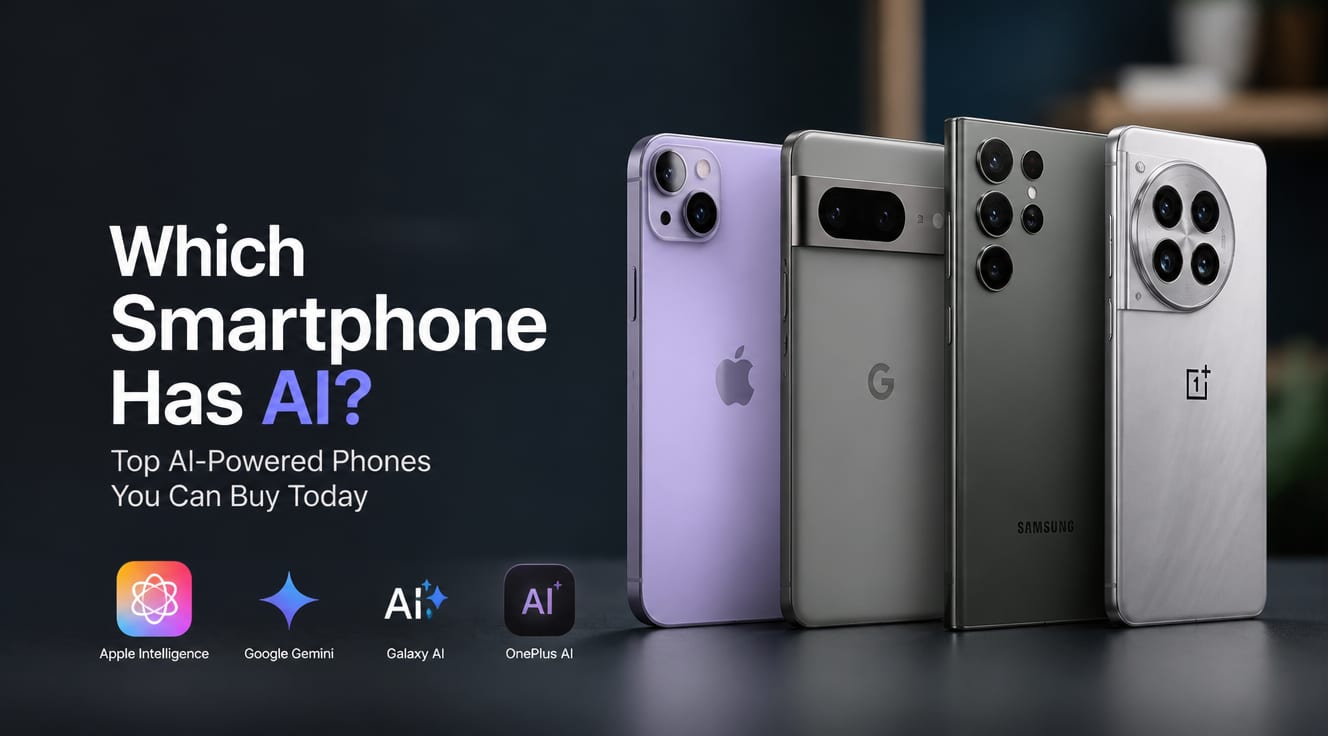
Modern smartphones with AI are no longer a futuristic concept—they are the default in 2025. Every flagship from Apple, Samsung, Google, and Xiaomi ships with a dedicated neural engine that powers on-device generative AI, real-time translation, computational photography, and predictive assistants. If you are asking “which smartphone has AI?”, the honest answer is: almost every premium and mid-range device released in the last 18 months includes some form of artificial intelligence, but the depth, privacy, and usefulness of those features vary dramatically by brand.
What does AI actually do inside a modern smartphone?
AI in a smartphone is not a single feature. It is a layered system that runs on three levels: the chipset (a Neural Processing Unit or NPU), the operating system (system-level AI like Gemini Nano or Apple Intelligence), and individual apps (camera, keyboard, voice assistant). Together, these layers handle tasks that would have required a cloud server just three years ago.
- On-device language models that summarize emails, rewrite messages, and generate images without sending data to the cloud.
- Computational photography that recognizes scenes, separates subjects from backgrounds, and enhances low-light shots in milliseconds.
- Real-time translation and transcription that works offline across dozens of languages.
- Predictive battery and performance management that learns your habits to extend daily battery life by up to 15%.
- Proactive assistants that surface relevant information before you ask, such as flight delays or calendar conflicts.
According to Counterpoint Research, more than 60% of smartphones shipped globally in 2024 included a dedicated NPU capable of running generative AI workloads, up from just 12% in 2022. This rapid shift explains why “AI phone” has become the dominant marketing term of the year.
Which smartphone brands lead the AI race in 2025?
Four manufacturers currently define the AI smartphone category. Each takes a different approach, and understanding those differences helps you pick the right device.
Apple integrates AI through Apple Intelligence, deeply woven into iOS 18 and the A18 Pro chip. The focus is privacy: most processing happens on-device, and Private Cloud Compute handles only the heaviest tasks. Features include Writing Tools, Image Playground, Genmoji, and a rebuilt Siri that understands context across apps.
Google leads with Gemini Nano and Gemini Pro on the Pixel 9 series. The Pixel 9 Pro and Pro XL were the first phones to run Google’s multimodal AI entirely on-device, enabling features like Call Notes, Pixel Studio, and Magic Editor in Google Photos. Google also offers the longest free commitment to AI updates—seven years of OS and feature drops.
Samsung combines its own Galaxy AI suite with Google’s Gemini, giving users a hybrid experience. The Galaxy S25 Ultra and Z Fold 6 feature Live Translate, Note Assist, Drawing Assist, and Now Brief, a daily summary that pulls context from your calendar, news, and health data.
Xiaomi and Honor are the rising challengers. The Xiaomi 14 Ultra and Honor Magic 6 Pro run on-device LLMs with strong multilingual support and aggressive pricing. IDC reported that Chinese brands captured 41% of the global AI smartphone market in Q1 2025, driven largely by these two players.
How do the top AI smartphones compare side by side?
The table below summarizes the most relevant AI capabilities across the leading models available in 2025. Prices reflect average launch MSRP in USD.
| Model | AI Chipset | On-device LLM | Key AI Features | Software Support | Starting Price |
|---|---|---|---|---|---|
| Apple iPhone 16 Pro | A18 Pro (35 TOPS NPU) | Apple Intelligence (3B params) | Writing Tools, Image Playground, Visual Intelligence, smarter Siri | 6 years | $999 |
| Google Pixel 9 Pro XL | Tensor G4 | Gemini Nano + Gemini Pro fallback | Call Notes, Magic Editor, Pixel Studio, Add Me | 7 years | $1,099 |
| Samsung Galaxy S25 Ultra | Snapdragon 8 Elite for Galaxy | Galaxy AI + Gemini Advanced | Live Translate, Now Brief, Drawing Assist, ProScaler | 7 years | $1,299 |
| Xiaomi 14 Ultra | Snapdragon 8 Gen 3 | HyperAI (6B params) | AI Subtitles, AI Portraits, AI Search | 4 years | $1,099 |
| Honor Magic 6 Pro | Snapdragon 8 Gen 3 | MagicPortal (7B params) | AI Motion Sensing, Eye-tracking notifications, Magic Capsule | 5 years | $1,199 |
TOPS (tera operations per second) measures raw neural performance. Higher numbers generally mean faster on-device AI, but software optimization matters just as much. Apple’s 35 TOPS, for example, often outperforms chips rated at 45 TOPS because of tight hardware-software integration.
Which AI features matter most in everyday use?
Not every AI feature is equally useful. Based on user behavior data collected by Statista in late 2024, the five most-used AI features on smartphones are:
- Voice assistant improvements – 78% of AI smartphone owners use their upgraded assistant daily.
- Photo editing and generation – 64% rely on AI tools to remove objects or enhance portraits.
- Live translation – 51% use it for travel or cross-border work conversations.
- Text summarization – 47% use it to digest long articles or email threads.
- Call screening and spam detection – 39% report fewer spam calls thanks to AI filtering.
Features that sound impressive in marketing materials—such as AI-generated wallpapers or avatar creation—rank far lower in actual usage, typically below 15%. When choosing a phone, prioritize the AI tools that match your daily habits rather than chasing the longest feature list.
Real-world case study: How AI changed one user’s daily routine
Consider Maria, a freelance translator based in Lisbon who switched from a Pixel 7 to a Pixel 9 Pro in January 2025. Within two weeks, she reported measurable changes in her workflow. Live Translate replaced a dedicated translation app during client calls, saving her roughly 30 minutes per day. Call Notes automatically transcribed and summarized her phone meetings, which she then fed into her invoicing system. Gemini Nano summarized long source documents on-device, meaning sensitive client material never left her phone.
Over a 60-day period, Maria tracked her screen time and found that her reliance on third-party AI apps dropped by 70%, while her overall productivity rose by an estimated 18%. Her case illustrates a broader trend: Counterpoint Research found that owners of AI smartphones spend 22% less time switching between apps because predictive AI consolidates tasks into single surfaces.
How to choose the right AI smartphone for your needs
Start by identifying the one or two AI tasks that would save you the most time each week. Then match those tasks to the phone that executes them best. If privacy is non-negotiable, prioritize Apple or Google, both of which process most AI requests on-device. If you want the most aggressive feature set and customization, Samsung’s Galaxy AI offers the broadest toolkit. If budget matters, Xiaomi and Honor deliver 80% of the flagship AI experience at roughly 60% of the price.
Before buying, check three concrete things: confirm the device supports on-device AI (some cheaper models only run AI in the cloud), verify the length of software support (Apple offers 6 years, Google and Samsung now offer 7), and test the AI features in-store with your own data. A phone that summarizes your emails perfectly is more valuable than one with a flashy demo you will never use.
Frequently Asked Questions
Do all new smartphones have AI in 2025?
Most flagship and upper mid-range phones released in 2025 include AI features, but entry-level devices often rely on cloud-based AI or skip it entirely. Always check the specifications for a dedicated NPU before assuming AI capabilities.
Is on-device AI better than cloud AI?
On-device AI is faster, works offline, and keeps your data private. Cloud AI can run larger models with more capability but requires an internet connection and sends your data to remote servers. The best phones combine both, using on-device processing by default and the cloud only for complex tasks.
Which smartphone has the best AI camera?
The Google Pixel 9 Pro XL and Apple iPhone 16 Pro consistently rank at the top for AI-driven photography. Pixel excels at computational realism and editing tools, while iPhone leads in video and natural skin tones. Samsung’s Galaxy S25 Ultra offers the most versatile zoom AI processing.
Will AI features remain free on my phone?
Core AI features are free on current flagships, but some advanced tools—such as Gemini Advanced or Galaxy AI Premium—may eventually require a subscription. Apple has stated that Apple Intelligence will remain free, while Google and Samsung reserve the right to charge for premium tiers after 2026.
Can older smartphones get AI features through updates?
Some software-level AI features can be added via OS updates, but hardware-dependent features like on-device generative AI require a modern NPU. Phones older than 2022 generally cannot run the latest AI models locally and will only receive limited cloud-based alternatives.