

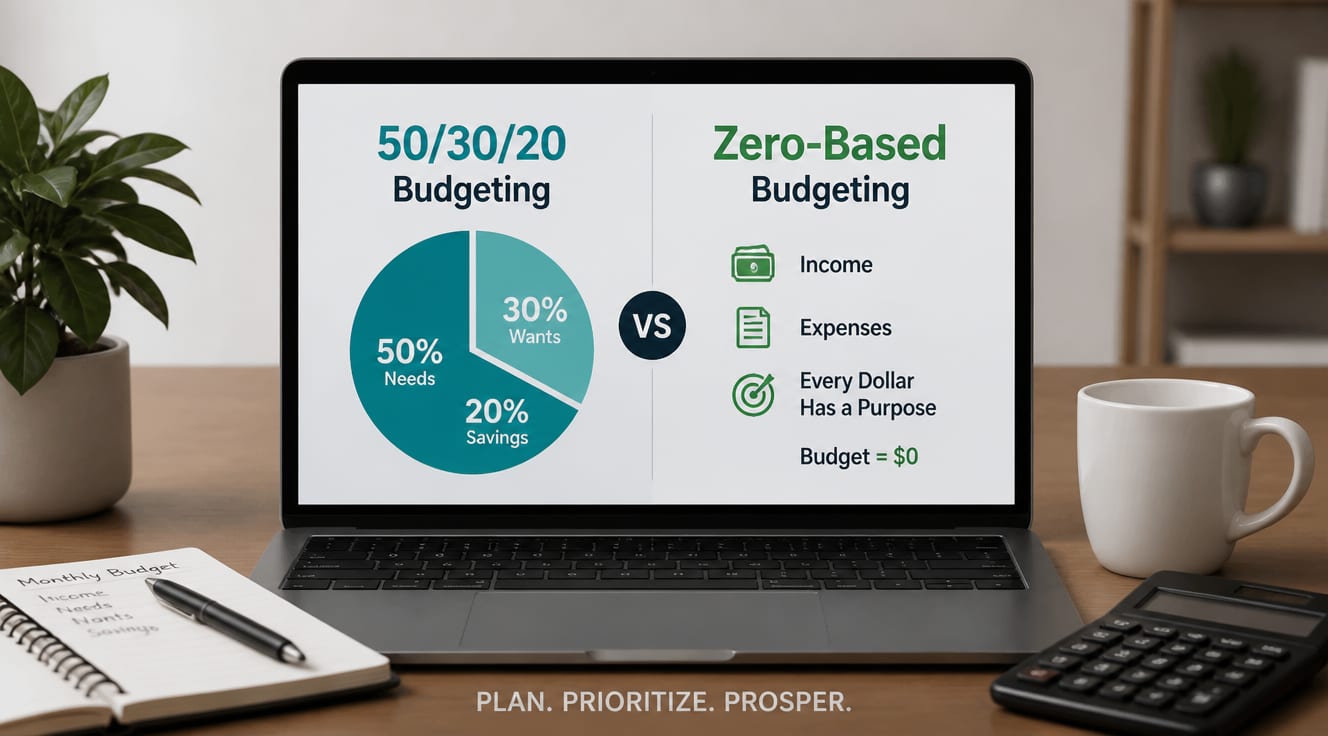
Choosing between the 50/30/20 rule and zero-based budgeting is one of the first decisions anyone makes when trying to take control of their money. Both methods are widely recommended by financial advisors, both are free, and both can transform your savings rate, but they work in fundamentally different ways. The 50/30/20 rule gives you a flexible framework, while zero-based budgeting demands that every dollar get a specific job. The right choice depends on your income stability, debt level, financial goals, and how much mental energy you want to spend tracking expenses each month.
What Are the Two Most Popular Budgeting Methods Right Now?
Personal finance experts consistently point to the 50/30/20 rule and zero-based budgeting as the two methods with the strongest track records. A 2023 NerdWallet report found that 32% of U.S. households use some form of structured monthly budget, and among those, the 50/30/20 framework is the most adopted at roughly 47% of budgeters, while zero-based budgeting accounts for about 19% according to a 2022 YNAB user survey. The remaining households use variations like the envelope system, the 70/20/10 rule, or custom tracking through budgeting apps.
The popularity gap is not accidental. The 50/30/20 method, popularized by Senator Elizabeth Warren in her book All Your Worth, requires about 10 minutes per month of active management. Zero-based budgeting, championed by Dave Ramsey and tools like YNAB, typically requires 30 to 60 minutes per week of attention. For people with irregular income or those new to budgeting, that difference in time commitment often becomes the deciding factor.
How Does the 50/30/20 Budget Rule Actually Work?
The 50/30/20 rule divides your after-tax income into three fixed categories. Fifty percent covers needs such as rent, utilities, groceries, insurance, and minimum debt payments. Thirty percent covers wants, including dining out, streaming subscriptions, hobbies, and vacations. The final twenty percent goes toward savings and extra debt repayment above the minimum.
The method’s strength lies in its simplicity. You calculate your percentages once per month, route your money into the right buckets, and then largely forget about it. According to Fidelity’s 2022 Financial Resolutions Study, people who automate their savings through a fixed-percentage method are 2.2 times more likely to stick with their savings plan for at least 12 months compared to those who save irregularly. The framework is forgiving by design, which keeps users engaged long enough to build a real habit.
The main limitation is precision. If your needs category exceeds 50% of your take-home pay, the rule breaks down immediately, and there is no built-in mechanism to address the shortfall other than cutting wants.
What Makes Zero-Based Budgeting Different?
Zero-based budgeting requires you to assign every single dollar of income to a category before the month begins, so that income minus expenses equals exactly zero. There is no slack, no “extra” money, and no floating buffer. If you earn $4,200 after tax, every cent of that $4,200 must have a destination, whether that is rent, savings, debt payoff, or a future category like Christmas gifts.
This approach is detailed, intentional, and powerful for people trying to eliminate debt or build an emergency fund aggressively. YNAB’s own 2023 outcomes report shows that new users reduce their spending by an average of $600 in their first two months and report a 68% increase in financial confidence after six months. The discipline required is also its biggest weakness. According to a Gallup poll from late 2023, 76% of Americans report financial stress at least sometimes, and zero-based budgeting can feel restrictive when life gets unpredictable.
50/30/20 vs Zero-Based: Side-by-Side Comparison
| Feature | 50/30/20 Rule | Zero-Based Budget |
|---|---|---|
| Time required per month | 1–2 hours total | 4–6 hours total |
| Best for | Beginners, steady income | Debt payoff, irregular income |
| Flexibility | High (categories are guidelines) | Low (every dollar is assigned) |
| Tracking frequency | Monthly | Weekly or per transaction |
| Savings rate achieved (typical) | 15–22% | 25–35% |
| Learning curve | Low | Moderate to high |
| Works without apps | Yes, easily | Difficult without tools |
| Failure mode | Overspending on wants | Budget fatigue and abandonment |
Which Method Fits Your Financial Situation Better?
The honest answer is that neither method is universally superior. The right pick depends on three personal variables.
Use the 50/30/20 rule if your income is predictable, your needs are below 50% of take-home pay, and you want a low-maintenance system that you can sustain for years. It is also the better entry point for couples who need to align around a shared framework without constant negotiation.
Use zero-based budgeting if you are actively paying down debt, your income varies month to month (freelancers, commission workers, gig economy), or you have a specific savings goal you want to hit within a fixed timeline. The granularity forces you to confront spending leaks that percentage-based methods can hide.
A 2024 survey by the Financial Industry Regulatory Authority (FINRA) found that 41% of Americans have no emergency fund at all, and among those who do, the median balance is only $2,000. If that describes your situation, zero-based budgeting will likely close the gap faster. If you already save consistently and just need a simple framework to stay on track, the 50/30/20 rule is more sustainable long-term.
Real Case Study: A Teacher’s Budget Reset
Consider Maria, a 34-year-old middle school teacher earning $52,000 per year. She tried the 50/30/20 rule for eight months and saved roughly $400 monthly, but she carried $11,000 in credit card debt and felt stuck. When she switched to zero-based budgeting using YNAB, she assigned every dollar weekly. Within three months, her monthly savings jumped to $1,150, and within fourteen months she paid off the credit card balance entirely.
The shift worked because zero-based budgeting forced her to confront small leaks, including four streaming subscriptions she rarely used and a $90 monthly food delivery habit. Under 50/30/20, those expenses were simply absorbed into the flexible “wants” category. Under zero-based, they had to be justified line by line. Maria’s case is consistent with YNAB’s published aggregate data showing that new users typically reallocate $300 to $700 per month from “untracked” spending into productive categories within the first 90 days.
Common Mistakes People Make With Both Methods
- Mixing the systems halfway. Assigning some categories with the 50/30/20 logic and others with zero-based precision usually leads to confusion and abandoned budgets.
- Ignoring irregular expenses. Annual insurance premiums, car repairs, and holiday gifts ruin both methods if you do not divide them by 12 and budget monthly.
- Forgetting to revisit the plan. A budget is not a one-time document. Review at least weekly, and recalibrate fully at the start of each month.
- Optimizing for perfection, not consistency. A “good enough” budget you actually follow beats a perfect one you abandon after three weeks.
Frequently Asked Questions
Is the 50/30/20 rule good for someone with debt?
It is acceptable but not aggressive. If you are trying to pay off high-interest debt quickly, the 20% allocation may not be enough. Many financial advisors recommend temporarily shifting to a 50/30/20 variation with 30% toward debt and 20% for wants, or switching to zero-based budgeting until the debt is eliminated.
Can I use zero-based budgeting if my income changes every month?
Yes, and it is actually one of its strongest use cases. You simply rebuild the budget from zero at the start of each pay period based on the income you actually received. This prevents the over-allocation problem that percentage-based systems create for freelancers and gig workers.
Which method builds savings faster?
Zero-based budgeting typically produces higher savings rates in the short term because the method forces allocation of every dollar. However, the 50/30/20 rule often produces better long-term results for average savers because the lower friction keeps them engaged for years rather than months.
Do I need a budgeting app to follow either method?
For the 50/30/20 rule, a spreadsheet or even a notebook is sufficient. For zero-based budgeting, a tool like YNAB, Monefy, or a detailed spreadsheet makes the system far more practical, especially when managing 15 to 30 distinct categories.
What if my needs exceed 50% of my income?
The 50/30/20 rule breaks down, and you should treat that as a signal, not a failure. Common adjustments include downsizing housing, refinancing loans, or temporarily increasing income through side work until the needs category drops back to the target range. If that is not realistic, zero-based budgeting will give you a clearer picture of which fixed expenses to attack first.
How to Pick and Start Your Budget Today
Start by pulling your last three months of bank and credit card statements and calculating your actual needs-to-wants ratio. If needs are under 50% and you want a sustainable system, set up the 50/30/20 rule today by opening three checking or savings sub-accounts, automating transfers on payday, and reviewing once per month. If needs are over 50%, you are carrying high-interest debt, or your income varies, download a zero-based budgeting tool, list every recurring expense, and build your first zero-based plan this weekend. The most important step is the one you take in the next 24 hours, because the best budgeting method is the one you will actually use for the next twelve months.