

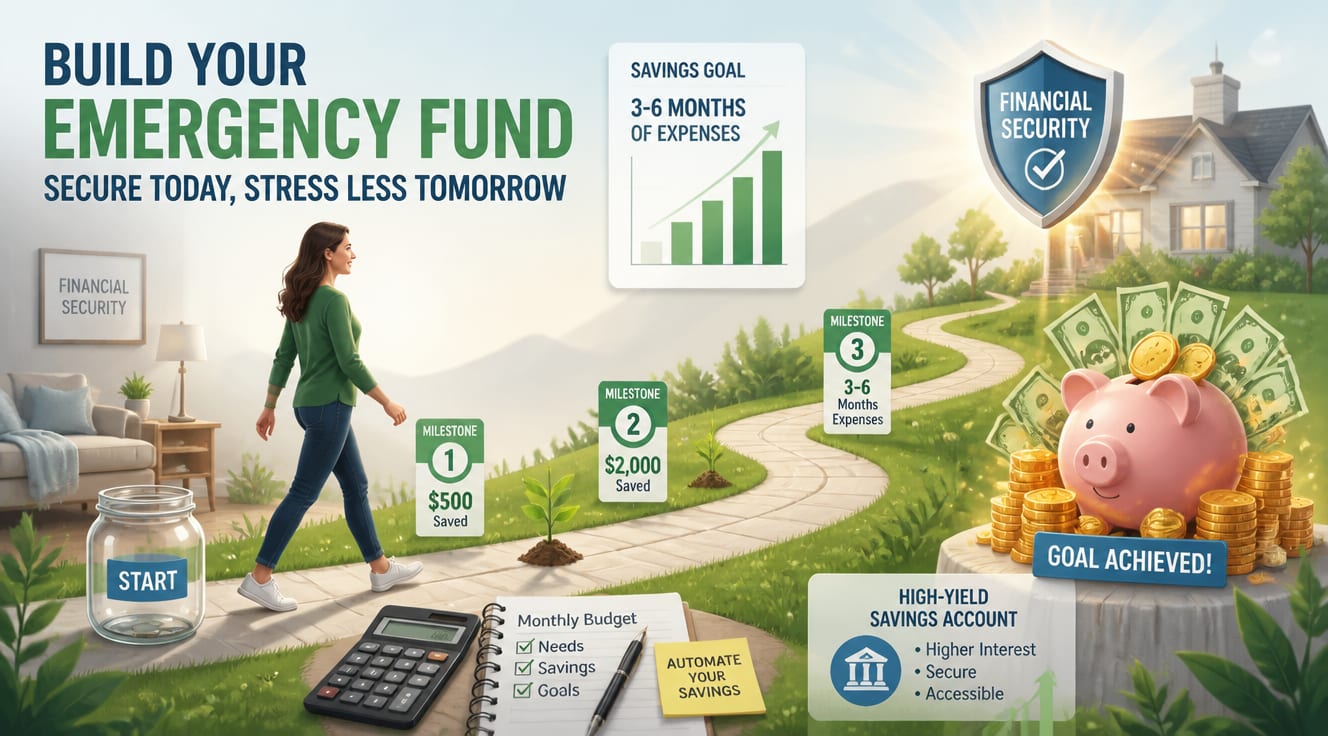
Building an emergency fund from scratch starts with calculating your essential monthly expenses, then setting a realistic savings target of three to six months’ worth of costs. Most financial advisors recommend keeping this money in a separate, easily accessible account so you are not tempted to spend it on daily life. According to the Federal Reserve’s 2023 Report on the Economic Well-Being of U.S. Households, 37% of adults would not be able to cover a $400 emergency with cash, which makes starting an emergency savings fund one of the most important first steps toward long-term financial security.
Whether you are living paycheck to paycheck, paying off debt, or simply beginning your savings journey, this guide gives you a practical, step-by-step process to build an emergency fund from zero. You will learn how to set a target, choose the right account, automate your contributions, and stay consistent even when money feels tight.
How Much Money Should You Keep in an Emergency Fund?
The standard rule of thumb is to save three to six months’ worth of essential living expenses. Essentials include rent or mortgage payments, utilities, groceries, insurance, transportation, and minimum debt payments. Discretionary spending like streaming subscriptions, dining out, and hobbies should not be included in your calculation.
To find your target number, multiply your total monthly essentials by three, six, or even twelve depending on your job stability. Freelancers, gig workers, and commission-based employees should aim closer to the six-to-twelve month range because their income is less predictable. Salaried employees in stable industries can start with a three-month goal and adjust later as life changes.
According to Bankrate’s 2024 Emergency Savings Report, only 44% of Americans have enough savings to cover three months of expenses, even though 61% reported experiencing an unexpected expense in the past year. This gap is exactly why learning how to build an emergency fund is one of the highest-impact financial skills you can develop in your lifetime.
Step-by-Step Plan to Build an Emergency Fund from Scratch
Starting from zero feels overwhelming, but breaking the process into small stages makes it manageable. Follow these steps in order to build your financial cushion one paycheck at a time.
- Track every dollar you spend for 30 days. Use a free budgeting app, a spreadsheet, or even a notebook. You need an honest picture of where your money goes before you can redirect any of it toward savings.
- Set a starter goal of $500 to $1,000. Federal Reserve data shows that 37% of adults cannot cover a $400 emergency, so even $500 covers most car repairs, medical copays, and minor household issues.
- Open a separate high-yield savings account. Keeping your emergency money in the same account as your checking balance is the fastest way to spend it. A separate account creates both a mental and physical barrier.
- Automate a transfer on payday. Even $25 or $50 per paycheck adds up over time. Automation removes willpower from the equation and makes saving a non-negotiable habit.
- Cut one recurring expense and redirect the savings. Cancel a subscription you rarely use, refinance insurance, or switch to a cheaper phone plan. Apply the monthly savings directly to your emergency fund.
- Use windfalls strategically. Tax refunds, bonuses, gift money, and side hustle income can fast-track your progress. Commit at least 50% of any windfall to your fund.
- Reassess every quarter. As your income or expenses change, adjust your monthly contribution so the fund keeps growing toward the three-to-six month target.
Where to Keep Your Emergency Fund: Account Comparison
Not every account is suitable for emergency savings. You want a balance of safety, liquidity, and decent interest. The table below compares the most common options available to U.S. consumers today.
| Account Type | Typical APY | Access Speed | Best For |
|---|---|---|---|
| High-yield savings account | 4.00% – 5.00% | 1–2 business days | Most people building an emergency fund |
| Money market account | 4.00% – 4.50% | Same day to 2 days | Those who want check-writing access |
| Traditional savings account | 0.01% – 0.50% | Same day to 1 day | Beginners who need instant access |
| Certificate of deposit (CD) | 4.50% – 5.00% | Locked until maturity | Not recommended for true emergencies |
| Checking account | 0.00% – 0.10% | Instant | Avoid; too easy to spend on non-emergencies |
The sweet spot for most people is a high-yield savings account at an FDIC-insured online bank. You earn competitive interest, your money is protected, and transfers back to your checking account usually settle within one business day.
Real Example: How Sarah Built a $5,000 Emergency Fund in 12 Months
Sarah, a 29-year-old marketing coordinator in Ohio, started with zero savings on a $42,000 salary. She followed a modified version of the steps above and reached her $5,000 goal in exactly one year.
- Month 1–2: Tracked every expense and identified $310 per month in non-essential spending she could cut.
- Month 3–4: Opened a high-yield savings account earning 4.35% APY and automated $200 per biweekly paycheck.
- Month 5–6: Cancelled two streaming services and a gym membership, redirecting $78 monthly to her fund.
- Month 7–9: Started a weekend side hustle doing social media work and saved 70% of the extra income.
- Month 10–12: Received a $1,200 tax refund and deposited 100% of it into the fund, hitting her $5,000 target one month early.
Sarah’s average monthly contribution was $417, but she never felt financially strained because the cuts and side income replaced spending she had previously been doing. Her fund now covers roughly three months of her essential expenses and gives her a level of peace that did not exist a year earlier.
Common Mistakes That Slow Down Emergency Fund Growth
Even motivated savers make avoidable errors. Watch out for these pitfalls as you learn how to build an emergency fund the right way.
- Saving without a target. Vague goals like “save more” rarely work. A specific dollar amount creates focus and motivation.
- Keeping the fund in a checking account. Without a barrier, you will treat it as a second spending account and drain it quickly.
- Investing the fund in stocks or crypto. Emergency money must be stable in value. A 30% market drop during a job loss could devastate your safety net.
- Pausing contributions when life gets busy. Consistency matters more than the amount. $10 a month kept going beats $500 contributed once.
- Using the fund for non-emergencies. Sales, vacations, and holiday gifts are not emergencies. Define what qualifies in advance, such as job loss, medical bills, or essential home repairs.
How to Apply This Starting Today
You do not need a perfect budget or a higher salary to begin. Take these three actions in the next 24 hours.
- Open a dedicated high-yield savings account. Research FDIC-insured online banks, compare current APYs, and complete the application today. Naming the account “Do Not Touch — Emergency Fund” adds a psychological guardrail that discourages impulse withdrawals.
- Set up an automatic transfer. Start with whatever amount your budget allows, even if it is only $10 per week. You can always increase it later once the habit is locked in.
- Schedule a 30-day money check-in. Block 20 minutes on your calendar one month from today to review your progress, adjust the transfer amount, and recommit to the goal.
The Bureau of Economic Analysis reported a U.S. personal savings rate of 3.5% in late 2024, meaning the average household is saving only a small fraction of income. By taking action today, you immediately put yourself ahead of the majority and start building the financial cushion that protects you from the next surprise bill, repair, or job transition.
Frequently Asked Questions
How long does it take to build an emergency fund from scratch?
Most people can reach a starter goal of $1,000 within three to six months by saving $50 to $100 per week. Reaching a full three-to-six month fund typically takes one to two years, depending on your income, expenses, and how aggressively you cut discretionary spending along the way.
Should I pay off debt or build an emergency fund first?
Financial planners usually recommend building a small starter fund of $500 to $1,000 first, then aggressively paying down high-interest debt. Once debt is under control, build the fund up to the full three-to-six month target. This sequence prevents you from going into more debt when an unexpected expense hits.
How much should I save each month for emergencies?
A common guideline is to save 10% to 20% of your take-home pay, but the right amount depends on your income and expenses. If 10% feels too aggressive, start with 5% and increase the percentage by one point every three months as your budget allows.
Can I use a Roth IRA as an emergency fund?
You can withdraw your Roth IRA contributions at any time without taxes or penalties, but doing so reduces your retirement savings and is not ideal. A high-yield savings account is a better option for true emergencies because it keeps your retirement money untouched and compounding over time.
What counts as a real emergency?
A real emergency is an unexpected, necessary, and urgent expense that threatens your health, safety, or ability to earn income. Examples include job loss, medical bills, car repairs needed to get to work, and essential home repairs like a broken furnace. Vacations, holiday gifts, and seasonal sales do not qualify.