

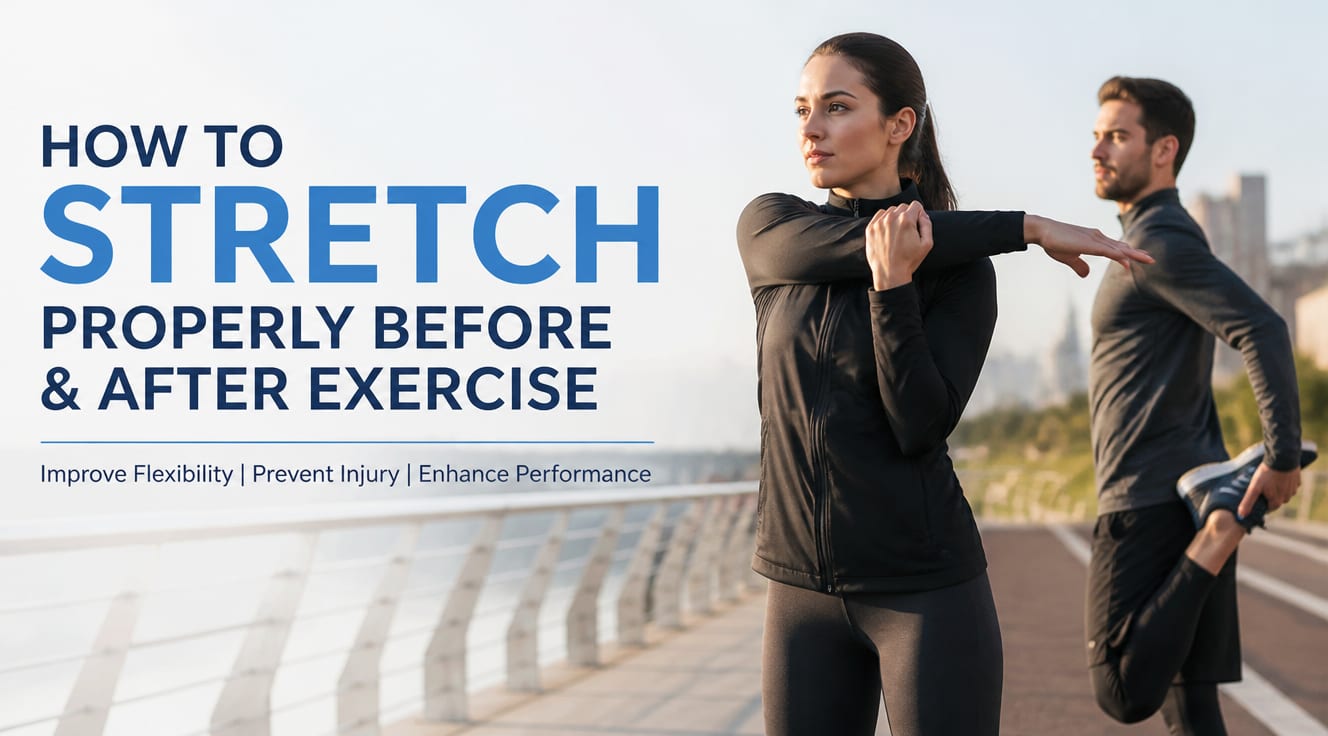
Proper stretching before and after exercise requires matching the technique to the timing: use dynamic stretches to warm up muscles before activity and static stretches to cool down and improve flexibility afterward. This approach reduces injury risk, enhances performance, and speeds up recovery, according to more than two decades of sports medicine research.
Most people stretch incorrectly, holding deep static positions before running or lifting weights, which can temporarily decrease muscle strength by up to 5.5% when held for 60 seconds or more, according to a 2019 meta-analysis in the Journal of Athletic Training. Understanding the difference between pre-workout and post-workout stretching is the first step toward building a safer, more effective routine.
Why Stretching Before and After Exercise Works Differently
Your muscles behave differently when they are cold versus warm and fatigued. Cold tissue has higher viscosity, lower elasticity, and is more prone to micro-tears when forced into a deep stretch. Warm tissue, in contrast, responds far better to lengthening because its collagen fibers are more pliable and the nervous system is more tolerant of range-of-motion changes.
For this reason, sports scientists now recommend two distinct protocols: one for warming up and one for cooling down. Treating them as the same activity is one of the most common mistakes in recreational fitness and one of the easiest to fix.
Pre-Workout vs Post-Workout Stretching: The Key Differences
The following table breaks down the recommended approach for each phase of your training session based on current exercise science guidelines.
| Factor | Pre-Workout Stretching | Post-Workout Stretching |
|---|---|---|
| Best Type | Dynamic stretching (movement-based) | Static stretching (held positions) |
| Duration | 5–10 minutes total | 5–15 minutes total |
| Hold Time | No hold, 8–12 controlled reps | 15–30 seconds per stretch |
| Intensity | Moderate, gradually increasing | Mild to moderate, no pain |
| Main Goal | Increase blood flow and range of motion | Restore muscle length, reduce soreness |
| Best Timing | Immediately before the main workout | Within 30 minutes of finishing |
| Consequence if Skipped | Higher risk of strains and pulls | Reduced long-term flexibility |
A 2014 study from the University of Milan found that athletes who performed dynamic stretching before sprinting improved their 20-meter time by an average of 3.6% compared to those who held static stretches. The same athletes also reported 25% less muscle soreness 24 hours later when they finished with static stretching, according to research published in the International Journal of Sports Physical Therapy.
The 4 Stretching Types You Need to Know
Not all stretching works the same way, and choosing the right style for the right moment makes a measurable difference in your results.
- Dynamic stretching: Controlled, sport-specific movements that take joints through their full range of motion, such as leg swings or arm circles. Ideal for warming up.
- Static stretching: Holding a single position for 15 to 60 seconds to lengthen a specific muscle, such as a seated hamstring stretch. Best for cooling down.
- PNF stretching: Contract-and-relax technique that uses isometric tension to reach deeper ranges of motion. Best done with a partner or qualified trainer.
- Ballistic stretching: Bouncing into a stretched position. Once popular, it is now generally discouraged due to elevated injury risk.
A Practical 7-Minute Pre-Workout Routine
Consider this real-world example: a 35-year-old recreational runner named Sarah used to hold static hamstring and quad stretches for 10 minutes before every run. She kept experiencing calf strains and shin splints. After switching to a dynamic warm-up, she completed her first full season injury-free. Her new routine looks like this:
- Leg swings (60 seconds): Hold a wall for balance, swing one leg forward and back 10 times, then side to side 10 times. Repeat on the other leg.
- Walking lunges with a twist (90 seconds): Perform 10 slow lunges, gently rotating the torso at the top of each rep to open the hips and activate the glutes.
- High knees in place (30 seconds): Drive each knee to hip height while pumping the arms to raise core temperature.
- Arm circles (30 seconds): Start with small forward circles for 15 seconds, then large reverse circles for 15 seconds to mobilize the shoulders.
- Inchworms (60 seconds): From standing, hinge at the hips, walk your hands out to a plank, then walk them back and stand. Repeat 5 to 8 times.
This routine takes about 7 minutes and primes the nervous system for activity without the temporary strength loss linked to prolonged static holds.
The Best Post-Workout Stretches for Faster Recovery
After exercise, your muscles are warm, pliable, and ready to be lengthened. The American Council on Exercise notes that approximately 30% of all sports injuries are related to inadequate flexibility, which is why the cool-down phase matters just as much as the warm-up.
Hold each of the following stretches for 20 to 30 seconds while breathing deeply. Never push into sharp pain.
- Standing hamstring stretch: Place one heel on a low surface, keep the knee slightly bent, and gently fold forward from the hips.
- Figure-four stretch: Lying on your back, cross one ankle over the opposite knee and pull the bottom leg toward your chest to release the glutes and piriformis.
- Doorway chest stretch: Place both forearms on a door frame and step one foot forward to open the front of the shoulders.
- Child’s pose: Kneel and sit back on your heels with arms extended forward to lengthen the entire back and lats.
- Standing quad stretch: Bend one knee, grab the ankle, and gently pull the heel toward your glutes while keeping the knees together.
Common Stretching Mistakes That Can Cause Injury
Even well-intentioned stretching can backfire. Avoid these frequent errors to get the most out of your routine.
- Stretching cold muscles statically: This is the most widespread mistake. Cold tissue does not respond well to long holds, increasing the risk of small tears.
- Bouncing into stretches: Ballistic movement triggers the stretch reflex, causing muscles to contract instead of lengthen.
- Holding your breath: Breath holding increases muscle tension. Exhale as you ease into each stretch.
- Stretching only the muscles you “feel”: Tightness in one area is often compensation for restricted tissue elsewhere in the body.
- Skipping stretching entirely: The American Heart Association reports that fewer than 5% of adults meet basic physical activity guidelines, and stretching is the first thing most people cut when time is short.
Frequently Asked Questions
How long should I hold a stretch after exercise?
For most people, holding each static stretch for 20 to 30 seconds is enough to improve flexibility without overloading the tissue. Longer holds of up to 60 seconds may offer additional benefits for athletes or those with significant restrictions, but anything beyond 90 seconds shows diminishing returns in most published studies.
Can I stretch before strength training?
Yes, but stick to dynamic movements. A 2019 meta-analysis in the Journal of Athletic Training found that static stretching held for 60 seconds or more reduced peak muscle strength by an average of 5.5%. Save static stretching for after your workout, when it can actually support recovery and long-term flexibility gains.
Is it okay to stretch every day?
Absolutely. Daily stretching, even on non-training days, is one of the most effective ways to maintain and improve range of motion. Just match the intensity to your state: gentle dynamic work on rest days, and deeper static holds after exercise or during a dedicated mobility session.
Does stretching prevent injuries?
Stretching alone is not a magic shield, but combined with a proper warm-up and progressive training, it reduces the risk of muscle and tendon strains. The American Council on Exercise estimates that roughly 30% of sports injuries involve flexibility deficits, so consistent stretching addresses a real and measurable risk factor.
Should I stretch if I am already sore?
Light stretching can help relieve delayed onset muscle soreness by increasing blood flow to the affected area. Keep the intensity low and avoid any movement that produces sharp pain. If soreness is severe, prioritize rest, hydration, and gentle movement like walking before returning to deeper stretches.
How to Build Your Stretching Routine Starting Today
The most effective stretching program is the one you actually do. Start small: add a 5-minute dynamic warm-up before your next two workouts and a 5-minute static cool-down after each one. Use the table above as your guide for choosing the right type at the right time.
Track your flexibility once every two weeks with a simple sit-and-reach test or by noting how a specific movement feels. After four weeks, expand your routine to 10 minutes on each side. Within three months, most people notice measurable improvements in mobility, fewer aches, and better performance during their actual workouts.
Stretching before and after exercise is not a luxury or an afterthought; it is a non-negotiable part of training intelligently. Start tonight, stay consistent, and let your body move the way it was designed to.