

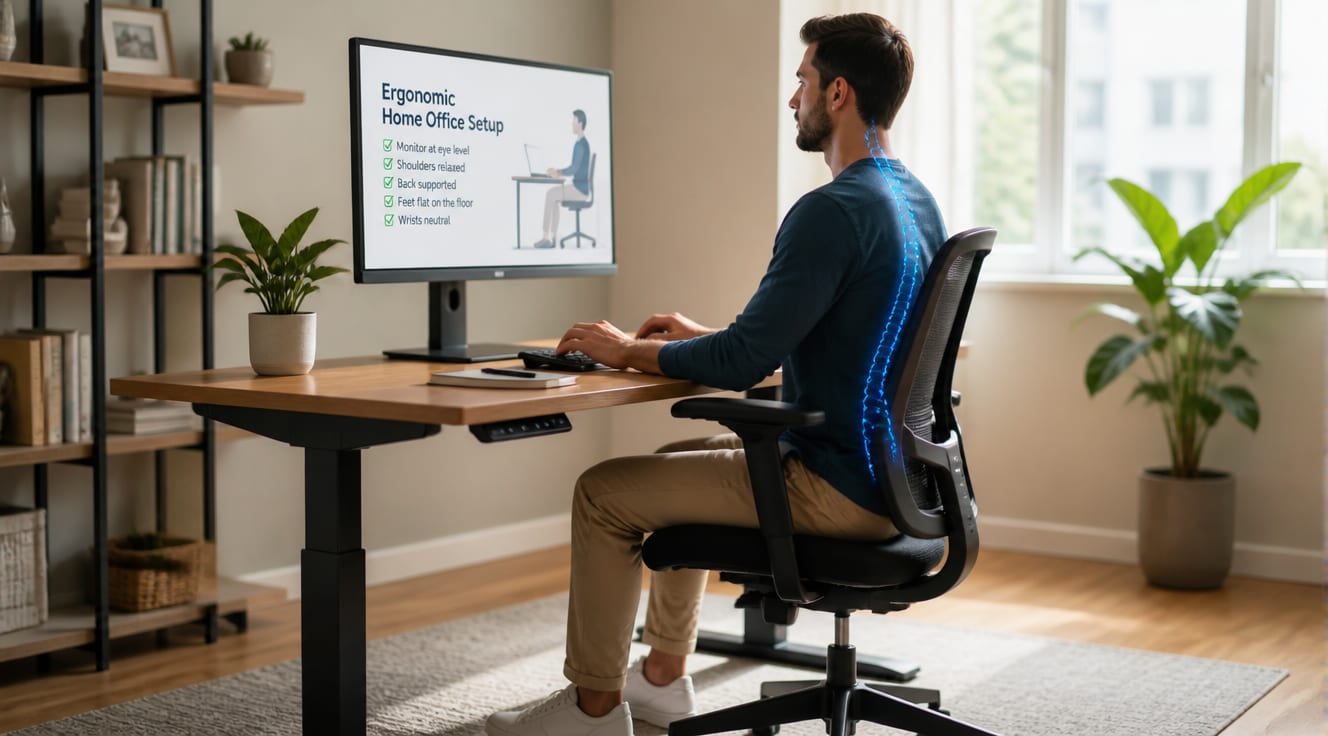
Sitting for 8–10 hours a day slowly reshapes your spine, weakens your core, and locks your shoulders into a forward-rounded position. The good news: you can improve posture when sitting all day by combining micro-habits, targeted exercises, and a properly tuned workstation — and most people see measurable results within 3–4 weeks of consistent practice
Why Sitting All Day Wrecks Your Posture
Your body is built for movement, not for static loading. When you remain seated for long stretches, several things happen at once: the hip flexors shorten, the glutes “switch off,” and the deep stabilizers of the spine stop firing. Over time, this muscle imbalance pulls your pelvis backward and your head forward, creating the classic “tech neck” and rounded-shoulder look
According to the World Health Organization, physical inactivity is the fourth leading risk factor for global mortality, responsible for an estimated 5 million deaths per year. Sitting too much is a major contributor to that inactivity, even for people who exercise after work
A 2018 study published in the Journal of Physical Therapy Science found that 73% of office workers reported musculoskeletal discomfort, with the lower back and neck being the most affected areas. The researchers linked these complaints directly to prolonged static sitting and poor workstation ergonomics
The Hidden Health Costs of Poor Sitting Posture
Bad posture is not just a cosmetic issue. It compresses internal organs, restricts diaphragm movement, and reduces blood flow to the brain. The American Chiropractic Association reports that 31 million Americans experience lower back pain at any given time, and sedentary desk work is one of the top three triggers
Research published in the British Medical Journal also showed that sitting for more than 8 hours a day increases all-cause mortality risk by roughly 20%, even among people who meet recommended exercise guidelines. In other words, your evening workout cannot fully cancel out a full day spent hunched over a laptop
Quick Posture Fixes You Can Apply in 5 Minutes
Before changing your chair or buying new gear, start with these no-cost corrections you can apply right now
- Reset every 30 minutes Stand up, walk 20 steps, then sit back down. A simple timer on your phone is enough
- Stack your bones Imagine a string pulling the crown of your head toward the ceiling; your ears should align over your shoulders, and your shoulders over your hips
- Unclench your jaw Jaw tension pulls the head forward. Let your lower teeth slightly separate and your tongue rest on the roof of your mouth
- Plant your feet flat Both feet on the floor, knees at roughly 90 degrees. If they don’t reach, use a small box or stack of books as a footrest
- Bring the screen to eye level The top of the monitor should sit at or just below eye height so your neck stays neutral
Best Posture Exercises for Desk Workers
Exercises are the long-term fix. They re-train the muscles that hold you upright so good posture becomes automatic instead of effortful. Aim for 10 minutes a day, ideally split into two short sessions
| Exercise | Target Area | Sets / Reps | Best Time to Do It |
|---|---|---|---|
| Chin tucks | Deep neck flexors | 3 × 10 holds (5 sec | Mid-morning break |
| Wall angels | Mid-back, rotator cuff | 3 × 8 slow reps | After lunch |
| Glute bridges | Glutes, posterior chain | 3 × 12 | Late afternoon |
| Doorway pec stretch | Chest, front delts | 2 × 30 sec per side | Whenever shoulders feel tight |
| Dead bug | Core stabilizers | 3 × 8 per side | End of workday |
Chin tucks and wall angels are especially effective because they directly counteract the forward-head and rounded-shoulder patterns that develop from screen work. Glute bridges wake up the posterior chain, which is essential for keeping the pelvis neutral while seated
How to Set Up an Ergonomic Workspace
No amount of exercise can fully compensate for a poorly designed workstation. Use this checklist to tune your setup in under 15 minutes
- Chair height Hips slightly above knees, thighs parallel to the floor
- Backrest angle Recline 100–110 degrees, not a strict 90. A slight tilt reduces disc pressure
- Lumbar support A small rolled towel or dedicated cushion fills the curve of your lower back
- Monitor distance An arm’s length (50–70 cm) from your eyes
- Keyboard and mouse Elbows close to 90 degrees, wrists straight, shoulders relaxed
If your employer offers a sit-stand desk, use it. Alternating between sitting and standing every 45–60 minutes reduces lower-back discomfort by up to 32%, according to a 2019 review in the International Journal of Environmental Research and Public Health</strong
A Real-World Case Study: How Sarah Fixed Her Posture in 30 Days
Sarah, a 34-year-old graphic designer in Austin, came to me with chronic neck pain and a visible forward-head posture. She sat for 9 hours a day and exercised only on weekends. Her plan was simple and repeatable
- Week 1 Added a 30-minute movement timer and switched to a chair with lumbar support
- Weeks 2–3 Did 10 minutes of chin tucks, wall angels, and dead bugs every morning
- Week 4 Replaced her afternoon coffee break with a 5-minute walk and doorway stretch
After 30 days, Sarah’s neck pain dropped from a 6/10 to a 2/10, and a posture photo comparison showed her head had moved roughly 2 cm closer to a neutral position. No special equipment, no expensive program — just consistency
How to Apply This Starting Today
Pick one habit from each section above and stack it onto something you already do. For example
- Do 10 chin tucks right after your morning coffee
- Set a phone reminder labeled “reset posture” every 45 minutes
- Add a rolled towel behind your lower back before tomorrow’s first meeting
Posture is a daily practice, not a one-time fix. Within two weeks these micro-actions will start feeling automatic, and within a month your body will thank you with less pain, more energy, and noticeably better alignment
Frequently Asked Questions
How long does it take to fix posture from sitting all day
Most people feel a difference in muscle awareness within 1–2 weeks. Visible structural changes in posture typically take 6–12 weeks of consistent daily practice, depending on how long the poor habits have been in place
Can a standing desk alone improve posture
A standing desk helps, but it is not a magic fix. Standing all day in the same hunched position can cause its own problems, including lower-back strain and varicose veins. The real benefit comes from alternating between sitting and standing every 45–60 minutes
What is the best chair for sitting all day
Look for adjustable lumbar support, a seat depth that leaves 2–3 fingers of space behind your knees, and armrests that keep your elbows at 90 degrees. Popular options include the Herman Miller Aeron, Steelcase Leap, and the Branch Ergonomic Chair for budget-friendly buyers
Do posture corrector braces work
Braces can remind you to sit up straight in the short term, but they do not strengthen the muscles needed to hold good posture on their own. Use them as a training aid for a few weeks while you build strength with targeted exercises, then phase them out
How often should I take breaks from sitting
Aim for a 2–5 minute break every 30–45 minutes. Research from the American Heart Association suggests that breaking up sitting every 30 minutes is more effective for metabolic health than a single longer break once per hour