

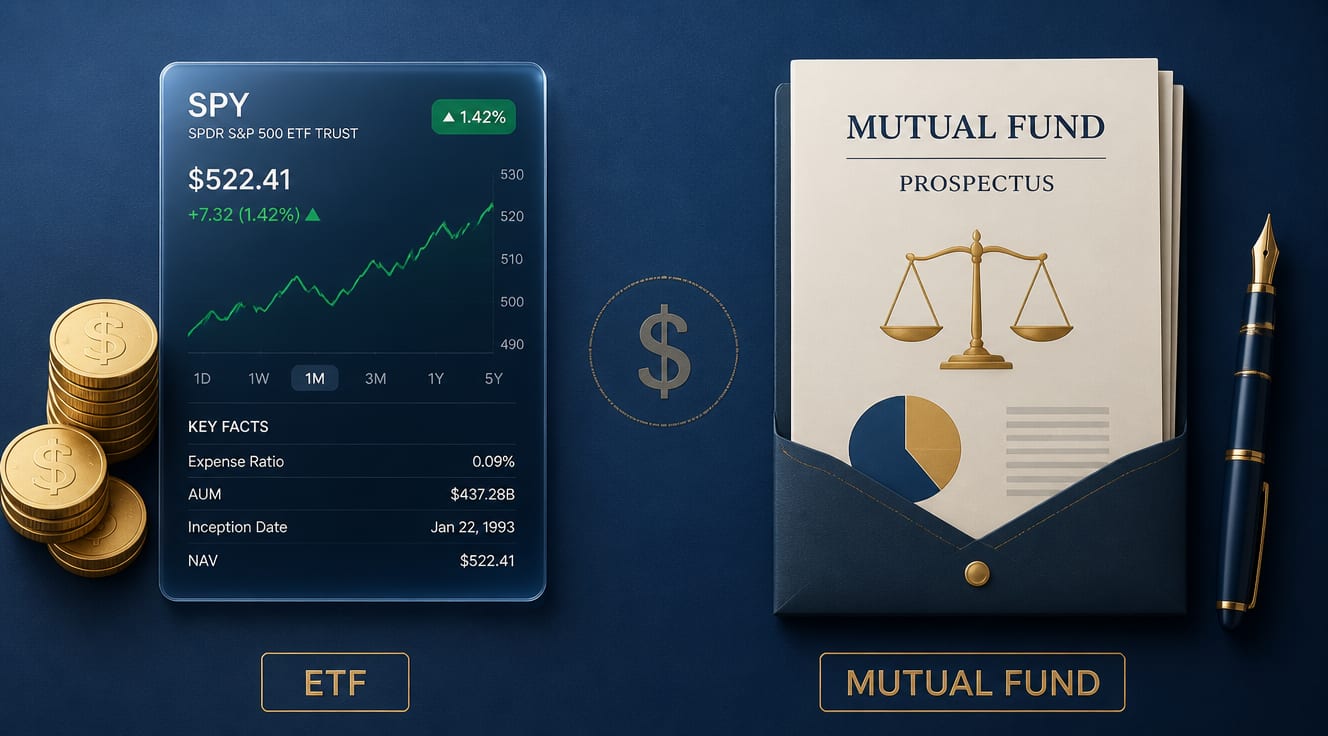
Choosing between ETFs vs mutual funds is one of the most common decisions new investors face, and the answer depends on how you invest, how much you have to start, and what you want to achieve. Both are pooled investment vehicles that give you exposure to a basket of stocks, bonds, or other assets, but they trade and operate very differently. Understanding these differences can save you thousands of dollars in fees and taxes over your investing lifetime.
What Are ETFs and Mutual Funds? A Quick Definition
An exchange-traded fund (ETF) is a fund that trades on a stock exchange like an individual stock, with prices that update throughout the trading day. A mutual fund, by contrast, is priced once per day after the market closes, and you buy or sell shares directly through the fund company or a broker.
Both structures let you own hundreds or thousands of securities through a single purchase, which makes them powerful tools for portfolio diversification. The mechanics behind them, however, are fundamentally different and that difference shapes everything from fees to tax efficiency.
ETFs vs Mutual Funds: The Core Differences
The table below summarizes the most important structural differences between the two investment vehicles.
| Feature | ETFs | Mutual Funds |
|---|---|---|
| Trading | Trades on exchanges throughout the day | Traded once per day at NAV |
| Minimum investment | Price of one share (often low) | Often $1,000–$3,000 |
| Pricing | Live market price (bid-ask spread) | Net Asset Value (NAV) at close |
| Management style | Mostly passive (index-tracking) | Active, passive, or hybrid |
| Expense ratio range | Typically 0.03%–0.30% | Typically 0.30%–1.50% |
| Tax efficiency | Generally high | Generally lower |
| Order types | Market, limit, stop-loss available | Market orders only |
How Fees Really Impact Your Returns Over Time
Fees are the single biggest long-term differentiator between ETFs vs mutual funds. Even a small difference in expense ratio compounds dramatically over decades.
According to Morningstar’s 2022 fund fee study, the average expense ratio for index mutual funds was 0.05%, while actively managed mutual funds charged an average of 0.41%. ETFs tracked similar patterns, with the cheapest index ETFs charging as little as 0.03% annually.
Consider this real-world example. Two investors each put $10,000 into a fund returning 7% annually before fees:
- Investor A pays 0.05% (low-cost ETF or index fund). After 30 years, the account grows to roughly $74,000.
- Investor B pays 1.00% (typical active mutual fund). After 30 years, the account grows to roughly $57,000.
The fee difference of less than 1% per year cost Investor B more than $17,000 in lost growth, without changing the underlying strategy at all.
When Mutual Funds Beat ETFs (and Vice Versa)
Despite the fee advantage of ETFs, mutual funds still have legitimate use cases, especially for specific investor situations.
A practical case study illustrates this clearly. Sarah, a 28-year-old teacher, opened a retirement account with just $200 per month. She chose a low-cost S&P 500 ETF because she could buy a single share for around $50 and reinvest dividends automatically. A mutual fund with a $3,000 minimum would have been out of reach.
Meanwhile, Mark, a 55-year-old planning retirement, chose an actively managed mutual fund focused on dividend income. He valued the access to a portfolio manager, automatic reinvestment at NAV, and the ability to invest a fixed dollar amount each month without worrying about share price fluctuations. For him, the higher fee was justified by the strategy and convenience.
Key situations where each vehicle tends to shine:
- ETFs work best when you want intraday liquidity, low costs, tax efficiency, or access to niche themes (commodities, sectors, specific indexes).
- Mutual funds work best when you invest small dollar amounts regularly, want professional active management, or need access to certain institutional share classes through your 401(k).
Tax Efficiency: The Hidden Cost Most Investors Miss
Tax efficiency is where ETFs often deliver a structural advantage that many investors overlook. Because of how ETFs use an in-kind creation and redemption process, they typically generate fewer capital gains distributions than mutual funds.
According to Investment Company Institute (ICI) data from 2023, U.S. ETFs held approximately $8.1 trillion in assets, while mutual funds held over $26 trillion. Despite holding less than one-third of the assets, ETFs have grown from roughly $1 trillion in 2010 to over $8 trillion in 2023, reflecting strong investor preference for tax-efficient, low-cost structures.
A separate 2023 S&P Dow Jones Indices SPIVA report found that more than 80% of large-cap actively managed mutual funds underperformed their benchmark over a 10-year period. This statistic is critical because it means most investors paying higher active-management fees are not receiving higher returns to justify them.
How to Choose Between ETFs and Mutual Funds Starting Today
You do not need to pick one vehicle forever. Most successful investors use both. Here is a simple decision framework you can apply right now:
- Check your account type first. If you are investing inside a 401(k), your options are usually limited to mutual funds. If you have a taxable brokerage or IRA, you can use either.
- Start with low-cost index options. For most investors, a total stock market or S&P 500 ETF or index mutual fund is the best default choice.
- Compare expense ratios, not just sticker price. Two funds tracking the same index can have wildly different fees. Always check the expense ratio before buying.
- Use ETFs for taxable accounts. Place tax-inefficient assets (bonds, REITs) in ETFs when possible to minimize annual tax drag.
- Use mutual funds for automatic dollar-cost averaging. Many mutual funds allow fractional share purchases, making them ideal for consistent monthly contributions.
Whichever you choose, the most important step is to start. Time in the market beats timing the market, and both ETFs and mutual funds give you that opportunity.
Frequently Asked Questions
Are ETFs safer than mutual funds?
Neither is inherently safer. Both are regulated investment products subject to the same oversight. The safety of your investment depends on the underlying assets, not the wrapper. Diversified index ETFs and mutual funds carry similar market risk.
Can you switch from mutual funds to ETFs?
Yes. You can sell your mutual fund shares and buy an ETF tracking the same or similar index. In taxable accounts, watch for capital gains triggered by the sale. In IRAs or 401(k)s, the switch is tax-free.
Do ETFs pay dividends like mutual funds?
Yes. ETFs distribute dividends from their underlying holdings, typically quarterly. You can reinvest these automatically or receive them as cash, just like with mutual funds.
Why are ETF expense ratios so much lower?
Most ETFs are passively managed and simply track an index, which requires minimal ongoing research and trading. Actively managed mutual funds employ analysts and portfolio managers, which drives up costs.
Which is better for beginners, ETFs or mutual funds?
For most beginners, low-cost index ETFs are the simplest starting point because they require no minimum investment, trade like stocks, and have very low fees. However, if your employer retirement plan only offers mutual funds, those are perfectly fine to start with.