

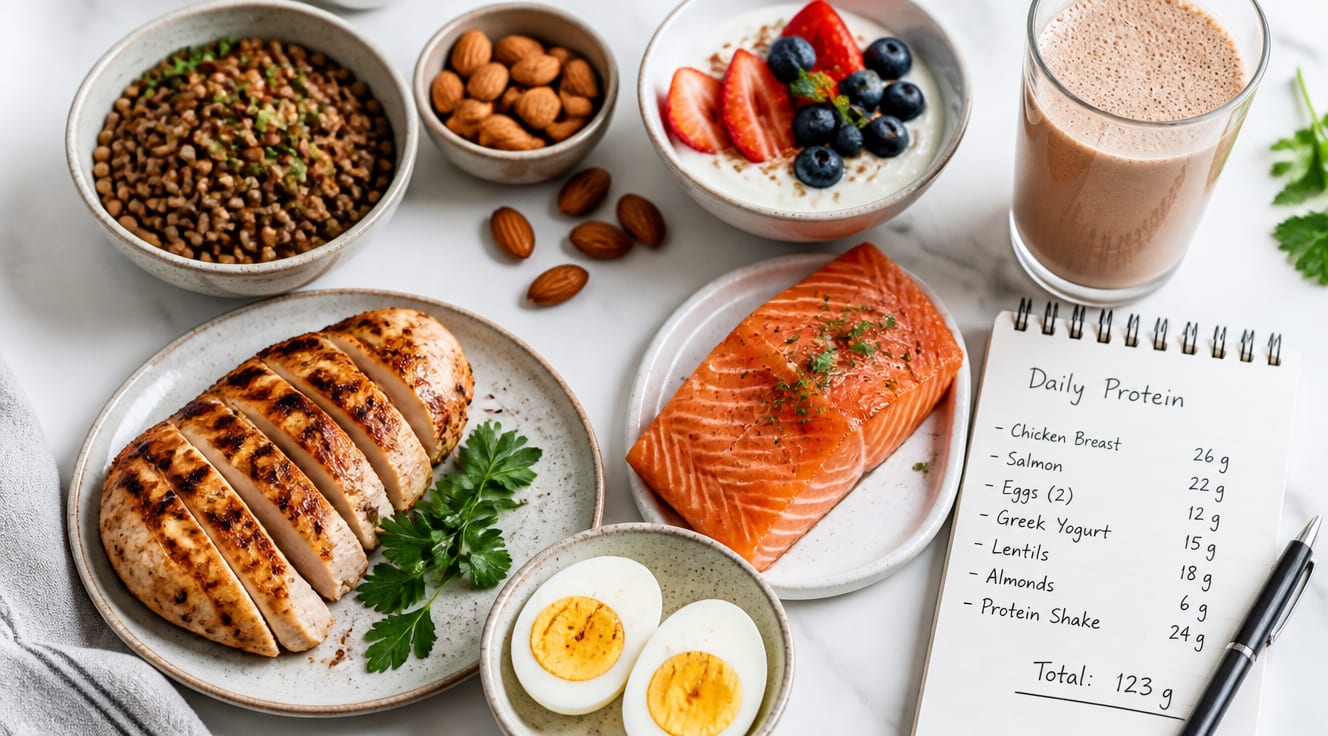
Most healthy adults need between 0.8 and 1.2 grams of protein per kilogram of body weight per day, with active individuals and older adults often requiring up to 2.2 g/kg. The exact amount depends on your weight, age, activity level, and fitness goals. For a 70 kg (154 lb) person, that translates to roughly 56–84 g of protein daily at baseline, and up to 154 g if you’re training intensely.
Protein is one of three macronutrients — alongside carbohydrates and fats — and it’s made up of amino acids that your body uses to build and repair muscle, produce enzymes and hormones, and support immune function. Unlike fats and carbs, your body can’t store protein efficiently, which is why you need to consume it regularly throughout the day.
What Is the Recommended Daily Protein Intake for Adults?
The Recommended Dietary Allowance (RDA) for protein in healthy adults is 0.8 grams per kilogram of body weight per day, according to the U.S. National Institutes of Health (NIH) and the World Health Organization (WHO). This is the minimum amount needed to prevent deficiency, not necessarily the optimal amount for muscle growth, recovery, or healthy aging.
For most people, this baseline works out to about 10–35% of total daily calories. The Acceptable Macronutrient Distribution Range (AMDR) set by the Institute of Medicine suggests protein should account for 10–35% of your daily caloric intake, depending on individual needs.
However, emerging research shows that many people benefit from consuming more than the RDA. A 2017 position stand from the International Society of Sports Nutrition found that protein intake between 1.6 and 2.2 g/kg per day optimizes muscle protein synthesis in active adults.
How Does Body Weight and Age Change Your Protein Needs?
Body weight is the single biggest factor in calculating your daily protein target. The simple formula is:
- Sedentary adults: 0.8–1.0 g/kg of body weight
- Moderately active adults: 1.0–1.4 g/kg
- Very active or strength-training adults: 1.6–2.2 g/kg
Age matters too. Adults over 65 need more protein to fight sarcopenia — the natural loss of muscle mass with aging. The PROT-AGE Study Group, supported by the European Geriatric Medicine Society, recommends 1.0–1.2 g/kg per day for older adults, and up to 1.5 g/kg for those with illness or malnutrition risk.
According to data from the U.S. Centers for Disease Control and Prevention (CDC), nearly 30% of adults aged 50 and over fail to meet even the basic protein RDA, increasing their risk of frailty and falls.
Protein Needs by Activity Level and Fitness Goal
Your goal changes the math. Whether you’re trying to lose fat, build muscle, or simply stay healthy, here’s how to dial in your intake:
| Activity Level / Goal | Protein (g/kg body weight) | Example: 70 kg adult | Example: 60 kg adult |
|---|---|---|---|
| Sedentary (minimal movement) | 0.8–1.0 g/kg | 56–70 g/day | 48–60 g/day |
| Lightly active (walking, daily tasks) | 1.0–1.2 g/kg | 70–84 g/day | 60–72 g/day |
| Moderately active (exercise 3–4x/week) | 1.2–1.6 g/kg | 84–112 g/day | 72–96 g/day |
| Strength training / muscle gain | 1.6–2.2 g/kg | 112–154 g/day | 96–132 g/day |
| Endurance athletes | 1.4–1.8 g/kg | 98–126 g/day | 84–108 g/day |
| Weight loss (preserve muscle) | 1.6–2.4 g/kg | 112–168 g/day | 96–144 g/day |
If you’re cutting calories to lose fat, protein becomes even more important. A higher protein intake (around 25–30% of total calories) helps preserve lean muscle mass while in a deficit, according to a 2014 meta-analysis in the American Journal of Clinical Nutrition.
Are You Getting Enough Protein? Common Signs of Deficiency
Most people in developed countries get enough total protein, but the quality and timing can still fall short. Watch for these signs:
- Constant hunger or sugar cravings
- Slow recovery after workouts
- Hair thinning or brittle nails
- Muscle weakness or loss of strength
- Frequent illness or slow wound healing
- Brain fog or trouble concentrating
If you notice several of these, your protein intake is likely too low or poorly distributed across the day.
Best High-Protein Foods to Hit Your Daily Target
Not all protein sources are equal. Animal proteins are “complete” — meaning they contain all nine essential amino acids — while most plant proteins are incomplete and need to be combined. Here are top options:
- Chicken breast (cooked): ~31 g protein per 100 g
- Greek yogurt (plain, non-fat): ~10 g per 100 g
- Eggs: ~6 g per large egg
- Cottage cheese: ~11 g per 100 g
- Salmon (cooked): ~25 g per 100 g
- Lentils (cooked): ~9 g per 100 g
- Tofu (firm): ~8 g per 100 g
- Whey protein powder: ~24 g per 30 g scoop
For plant-based eaters, combining foods like rice and beans, or hummus and whole-grain pita, gives you a complete amino acid profile.
Common Protein Myths You Should Stop Believing
There’s a lot of misinformation out there. Let’s clear up the most common myths:
- “Too much protein damages your kidneys.” Multiple reviews, including one in the Journal of the International Society of Sports Nutrition (2013), show no harmful effects of high protein intake on kidney function in healthy individuals.
- “You can only absorb 30 g of protein per meal.” Your body can absorb more than 30 g in one sitting, though muscle protein synthesis is optimized at around 0.4 g/kg per meal, per a 2016 study in Cell Reports.
- “Plant protein isn’t as good as animal protein.” Plant proteins can fully support muscle growth when consumed in slightly higher amounts and varied sources, per a 2019 review in the British Journal of Nutrition.
- “More protein always means more muscle.” Beyond ~2.2 g/kg, additional protein doesn’t appear to boost muscle growth further in trained athletes.
How to Calculate and Track Your Daily Protein: A Real Example
Let’s say Sarah is a 32-year-old woman weighing 65 kg who strength-trains four times a week and wants to lose fat while keeping her muscle.
- Goal: weight loss with muscle preservation
- Target: 1.8 g/kg (mid-range for fat loss)
- Daily protein: 65 × 1.8 = 117 g of protein per day
She splits it across four meals:
- Breakfast: Greek yogurt + eggs (30 g)
- Lunch: Chicken salad (35 g)
- Snack: Whey shake + almonds (25 g)
- Dinner: Salmon + quinoa (27 g)
Total: 117 g. By hitting this target consistently, Sarah preserves lean mass during her cut and recovers faster between sessions. This approach is supported by the ISSN’s 2017 position stand on nutrient timing.
How to Apply This Starting Today
You don’t need a complicated plan to get started. Here’s a simple 3-step approach:
- Calculate your baseline. Multiply your body weight (in kg) by 1.2 if you’re moderately active, or 1.6–2.0 if you train hard. That’s your daily protein target in grams.
- Anchor each meal with protein. Aim for 20–40 g per meal. A palm-sized portion of meat, fish, tofu, or a scoop of protein powder works well.
- Track for one week. Use an app like MyFitnessPal or Cronometer to log your intake. After seven days, you’ll know exactly where you stand and what to adjust.
If you’re over 65, recovering from injury, or following a vegan diet, add 10–20% to your target to be safe.
Frequently Asked Questions
Is 100 g of protein a day enough?
For most sedentary adults, 100 g per day is more than enough. For active individuals or those trying to build muscle, 100 g may fall short — especially if you weigh more than 60–70 kg. Always calculate based on your body weight and activity level.
Can you build muscle on 1 g/kg of protein?
You can make some progress, but research consistently shows 1.6–2.2 g/kg is more effective for maximizing muscle hypertrophy. A 2018 meta-analysis in the Journal of Sports Sciences found significantly greater muscle gains above 1.6 g/kg in resistance-trained individuals.
What happens if I eat too much protein?
In healthy people, excess protein is simply stored as fat or excreted. There is no strong evidence that high protein intake causes kidney damage in individuals without pre-existing kidney disease, per a 2020 review in Nutrients.
Is it better to spread protein across meals or eat it all at once?
Spreading protein across 3–4 meals (each containing 0.3–0.5 g/kg) is slightly better for muscle protein synthesis than eating it all in one sitting, according to a 2014 study in the Journal of Nutrition.
Do I need protein powder to hit my daily target?
No. Protein powder is convenient but not necessary. Whole foods like eggs, chicken, fish, dairy, legumes, and tofu can easily get you to your daily target if planned properly.