

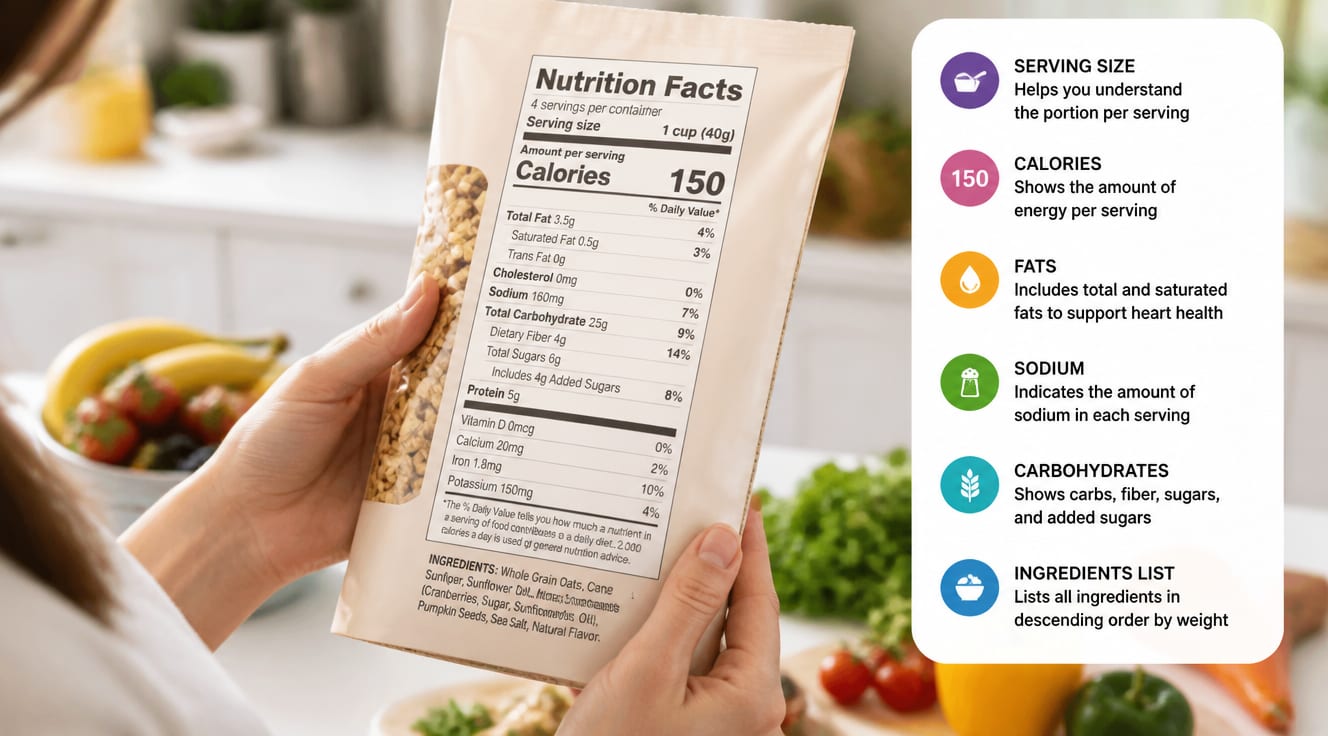
Reading a nutrition label starts with checking the serving size at the top, then scanning calories, followed by the nutrients you want to limit (saturated fat, sodium, added sugars) and the ones you want more of (fiber, protein, vitamins). The ingredients list on the back reveals what is actually in the food, with entries listed in descending order by weight. Mastering this ten-second scan lets you compare products, spot hidden sugars, and align every grocery purchase with your health goals.
Why Nutrition Labels Matter More Than You Think
Nutrition labels are among the most underused tools in the grocery aisle. According to the U.S. Food and Drug Administration (FDA), fewer than half of consumers report checking the Nutrition Facts panel when buying a product for the first time, even though packaged foods account for roughly 75% of the dietary sodium and added sugar consumed in the U.S. (FDA, 2022).
The World Health Organization estimates that excessive sodium intake contributes to approximately 2.5 million deaths globally each year, primarily through elevated blood pressure and cardiovascular disease (WHO, 2023). At the same time, the Centers for Disease Control and Prevention reports that only about 5% of adults meet the recommended daily fiber intake of 25 to 38 grams (CDC, 2023). These numbers share one common cause: people do not always know how to translate a food’s package into its real nutritional impact.
Anatomy of the Nutrition Facts Label
Since 2016, the FDA has required a standardized format for nutrition information. Knowing what each section means turns a cluttered box of numbers into a clear decision-making tool. Here are the core sections and what they tell you:
- Serving size: the baseline amount every number refers to.
- Calories: total energy per serving; 40 is low, 100 is moderate, 400+ is high.
- Total Fat, Saturated Fat, Trans Fat: focus on saturated and trans fats, which raise LDL cholesterol.
- Sodium: keep daily intake under 2,300 mg per FDA guidelines.
- Total Carbohydrate, Fiber, Total Sugars, Added Sugars: fiber is what you want; added sugars are what you limit.
- Protein: supports satiety, muscle maintenance, and stable blood sugar.
- Percent Daily Value (%DV): how much one serving contributes to a 2,000-calorie reference diet.
Serving Size: The Number Most People Get Wrong
The serving size is the most commonly misread element on a nutrition label. A bag of chips labeled 150 calories per serving can actually deliver 600 calories per bag, because the package holds four servings. The FDA requires manufacturers to base serving sizes on typical consumption, but typical is not always the same as what you eat.
A quick rule of thumb: read the serving size in bold text, count how many servings the package contains, then multiply every number below by that count to see what you would actually consume by finishing the whole item.
Calories, Fats, and Percent Daily Value Explained
The Percent Daily Value (%DV) column tells you whether a nutrient is high or low in one serving. The FDA defines the following reference points, and keeping them in mind turns label reading into a fast comparison exercise:
| Nutrient | 5% DV or Less (Low) | 20% DV or More (High) |
|---|---|---|
| Saturated Fat | Choose often | Choose rarely |
| Sodium | Choose often | Choose rarely |
| Dietary Fiber | Choose rarely | Choose often |
| Protein | Choose rarely | Choose often |
| Added Sugars | Choose often | Choose rarely |
| Cholesterol | Choose often | Choose rarely |
When you compare two yogurts, for example, the one with lower %DV for added sugars and higher %DV for protein wins, regardless of brand, packaging claims, or price.
How to Decode the Ingredients List Like a Detective
Ingredients must appear in descending order by weight, which makes the top three entries the most important to evaluate. Use this ordered checklist every time you flip a package over:
- Look for sugar aliases: anything ending in “-ose” (fructose, dextrose, sucrose, maltose) plus honey, syrup, molasses, cane juice, and fruit concentrate all count as added sugar.
- Identify refined grains versus whole grains: “whole wheat,” “brown rice,” “oats,” or “quinoa” should appear in the top three ingredients for a genuinely whole-grain product.
- Watch for hidden sodium sources: salt, sodium nitrate, MSG, and sodium benzoate all count toward your daily sodium intake.
- Note industrial fats and oils: partially hydrogenated oils indicate trans fats, which the FDA effectively banned from foods in 2020 but may still appear in trace amounts on older labels.
- Recognize ultra-processed markers: long chemical-sounding names, emulsifiers, and artificial flavors suggest high industrial processing.
As a general rule, if you cannot pronounce or recognize an ingredient, the product is far from whole food.
Real-World Example: Comparing Two Breakfast Cereals
Picture two cereals sitting side by side on a shelf: Brand A “Honey Crunch” and Brand B “Oat Bran Flakes.” Here is exactly what their labels reveal to a careful shopper:
| Component (per serving) | Brand A: Honey Crunch | Brand B: Oat Bran Flakes |
|---|---|---|
| Serving size | 30 g | 40 g |
| Calories | 120 | 150 |
| Total Sugars (Added) | 12 g (10 g added) | 4 g (0 g added) |
| Dietary Fiber (%DV) | 1 g (4% DV) | 5 g (18% DV) |
| Sodium (%DV) | 110 mg (5% DV) | 85 mg (4% DV) |
| First ingredient | Milled corn, sugar | Whole grain oat bran |
At first glance, Brand A appears lighter at 120 calories, but 10 grams of added sugar and only 1 gram of fiber make it a weak breakfast foundation that may trigger mid-morning hunger. Brand B’s zero added sugar profile plus 5 grams of fiber and a true whole-grain first ingredient delivers steadier energy, longer satiety, and better blood-sugar control. This kind of side-by-side comparison, made in seconds using nutrition labels alone, is what separates a 60-second decision from a 60-second impulse.
Smart Strategies for Faster Label Scanning
Once you know what to look for, a full label scan should take less than ten seconds. These shortcuts help you build the habit quickly and reduce decision fatigue at the store:
- Start with the “Big Three,” meaning calories, added sugars, and sodium, and ignore the rest on first pass.
- Apply the 5-20 rule for every %DV: 5% or less is low, 20% or more is high.
- Compare products by grams per serving, not per package, and treat multi-serving bags, bottles, and boxes with suspicion.
- Shop by ingredients list first and Nutrition Facts second; the front of the package sells claims, the back sells truth.
- Snap a quick phone photo of everything in your cart; reviewing it later reveals the patterns in your buying habits.
How to Start Reading Labels Like a Pro Today
Pick one product you already own and read its full nutrition label, end to end, tonight at dinner. Notice the serving size, the %DV totals, and the first three ingredients. Tomorrow at the store, choose one new product and apply the same scan before placing it in the cart. By the end of the week, you will have reviewed seven products and built a working framework for every shopping trip after. Within a month, label reading becomes second nature, and your grocery list quietly turns into a tool for better health, not just better taste.
Frequently Asked Questions
What does %DV actually mean on a nutrition label?
%DV shows how much one serving of a food contributes to your daily nutrient needs, based on a 2,000-calorie reference diet. A nutrient providing 20% DV or more is considered high, while 5% DV or less is considered low. Use it to spot which products add too much of what to limit, such as saturated fat, sodium, and added sugars, and which ones boost what you need more of, including fiber, protein, and key vitamins.
How can I tell if a food has too much added sugar?
Look at the “Added Sugars” line directly under “Total Sugars” on the Nutrition Facts panel. The FDA recommends limiting added sugars to no more than 10% of daily calories, roughly 50 grams on a 2,000-calorie diet. Anything with more than 10% DV per serving is high, and an ingredients list showing sugar, syrup, or any “-ose” word among the top three positions confirms the product is sugar-heavy.
Are calories listed per serving or per package?
Calories are listed per serving, not per package. The serving size sits at the top of the Nutrition Facts panel in bold text, and the total number of servings per container appears directly beneath it. Many cereals, drinks, and snack bags contain two to four servings, so multiplying the listed calories by that number reveals the real total if you finish the whole package.
Which ingredients matter most on the list?
The first three ingredients matter most because they are listed in descending order by weight and make up the bulk of the product. Watch for refined grains, hydrogenated oils, and hidden sugars in these top spots. Ingredients appearing lower on the list matter less for daily nutrition, though long lists of preservatives, emulsifiers, and artificial flavors are a strong signal that the food is highly processed.
Can nutrition labels mislead shoppers?
Labels are strictly regulated by the FDA in the U.S. and similar agencies worldwide, but they can mislead when serving sizes are unrealistic or when marketing claims on the front (“natural,” “light,” “high protein”) overstate the actual nutrition inside. Always verify front-of-package claims by reading the full Nutrition Facts panel and the ingredients list before trusting them.